
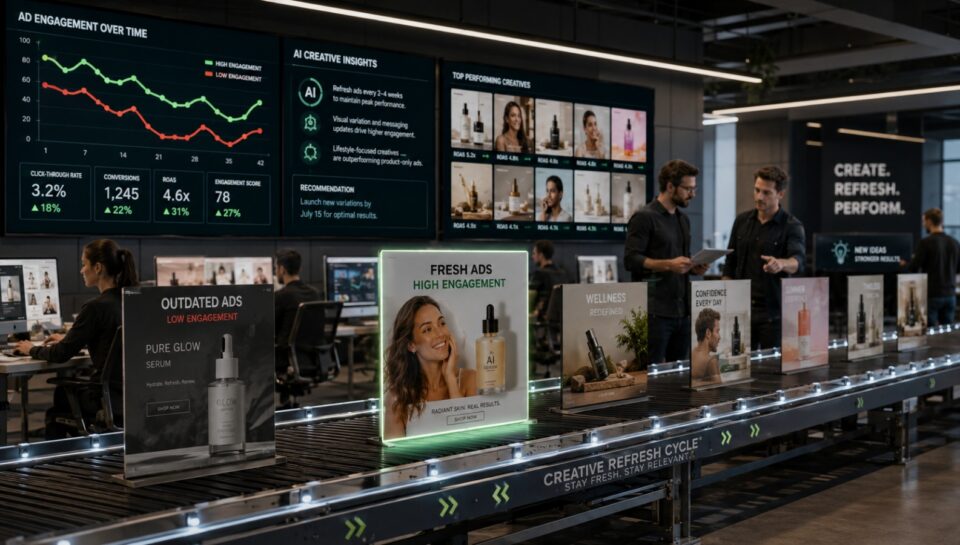
If your ecommerce ads started strong but your ROAS suddenly dropped, your CPC increased, and conversions slowed, you’re probably dealing with one of the biggest challenges in digital advertising: ad fatigue.
Many ecommerce brands assume the solution is to increase budgets, change targeting, or switch platforms. In reality, the problem is often much simpler: your audience has already seen your creative too many times.
Today’s consumers scroll through thousands of ads every week. Even great campaigns lose effectiveness when shown repeatedly.
So the real question becomes:
How often should ecommerce brands refresh their ads?
The short answer is every 2–4 weeks for high-spend campaigns, but the ideal timeline depends on your audience size, budget, campaign objective, and creative performance.
In this guide, you’ll learn:
- Why do ad creatives stop performing
- Signs it’s time to refresh your ads
- How often do successful ecommerce brands update creatives
- Best practices to avoid creative fatigue
- How AI helps brands produce fresh ads faster

Why Ecommerce Ads Stop Working
Most brands blame the algorithm when performance drops.
In reality, platforms like Meta and TikTok are excellent at finding buyers—but they can’t make people engage with the same creative forever.
When users repeatedly see identical images or videos, they begin ignoring them. This is called ad fatigue.
As ad fatigue grows, you’ll typically notice:
- Higher Cost Per Click (CPC)
- Higher Cost Per Acquisition (CPA)
- Lower Click-Through Rate (CTR)
- Declining Return on Ad Spend (ROAS)
- Lower engagement
- Reduced conversions
The algorithm isn’t necessarily failing.
Your creativity is simply losing its ability to capture attention.
What Is Ad Fatigue?
Ad fatigue happens when your target audience sees the same advertisement too many times.
Instead of attracting attention, your creative becomes familiar—and familiar ads are easy to ignore.
Think about scrolling through social media.
The first time you see an interesting video, you stop.
The tenth time?
You barely notice it.
That’s exactly what happens with ecommerce advertising.
How Often Should You Refresh Ecommerce Ads?
There isn’t one universal answer.
Instead, follow these practical guidelines.
High-Spend Campaigns
If you’re spending $500–$1,000+ per day, refresh your creatives every 2–3 weeks.
Large budgets expose ads to the same audience quickly, increasing ad fatigue.
Medium-Spend Campaigns
Brands spending $100–500 daily should introduce fresh creatives every 3–4 weeks.
You may not need completely new concepts each time. Often, refreshing hooks, headlines, or visuals is enough.
Low-Spend Campaigns
Smaller ecommerce stores spending under $100/day can often refresh creatives every 4–6 weeks, depending on performance metrics.
Always prioritize data over a fixed schedule.
Signs Your Ads Need Refreshing
Don’t wait until performance collapses.
Watch for these warning signs:
Falling Click-Through Rate (CTR)
If fewer people click your ads, your creative may no longer stand out.
Rising Cost Per Acquisition (CPA)
When acquisition costs climb without other major changes, creative fatigue is often responsible.
Increasing Frequency
Frequency measures how often people see your ads.
Once frequency becomes consistently high and results decline, it’s time to introduce new creative.
Lower ROAS
A declining Return on Ad Spend often signals that audiences have become less responsive.
Reduced Engagement
Fewer likes, comments, shares, and saves usually indicate your creative is losing its impact.
Refreshing Ads Doesn’t Mean Starting From Scratch
Many marketers believe refreshing creatives means producing entirely new campaigns every month.
That’s unnecessary.
Instead, refresh individual creative elements.
For example:
- Use a new opening hook
- Change the first three seconds of the video
- Replace product angles
- Update headlines
- Test different offers
- Add customer testimonials
- Change music
- Use different UGC creators
- Test seasonal messaging
- Update thumbnails
Small changes often generate significant performance improvements.
Build a Creative Testing System
The most successful ecommerce brands don’t rely on one “winning ad.”
They constantly test.
A simple creative testing framework might include:
- Three new video ads every week
- Two new image ads
- Different hooks
- Multiple headlines
- Various CTAs
- Different audience pain points
This creates a steady pipeline of fresh content while identifying the best-performing creatives.
Testing beats guessing.
Why Creative Is Now More Important Than Targeting
Privacy updates and AI-powered advertising platforms have changed digital marketing.
Algorithms handle much of the audience targeting.
Your competitive advantage is now your creative.
Brands that consistently launch fresh, engaging ads usually outperform brands that endlessly optimize audiences while running outdated creatives.
In modern ecommerce advertising:
Creative has become the biggest growth lever.
Read more: Why Your Product Page Can’t Fix Bad Ad Creative
How AI Makes Creative Refreshes Faster
Producing professional ad creatives every few weeks used to require photographers, videographers, editors, actors, and expensive production budgets.
Today, AI dramatically simplifies the process.
With AI-powered creative production, ecommerce brands can:
- Generate multiple ad variations quickly
- Produce cinematic product videos
- Create lifestyle product visuals
- Test different messaging angles
- Launch campaigns faster
- Reduce production costs
- Scale creative testing without increasing budgets
This allows marketers to refresh ads more frequently without overwhelming their creative teams.

How Fotyra Helps Ecommerce Brands Stay Ahead
Keeping ad creatives fresh doesn’t have to mean expensive photoshoots or weeks of production.
Fotyra helps ecommerce brands generate high-quality AI-powered product images and cinematic product videos designed for modern advertising.
Whether you’re testing multiple creative concepts, launching seasonal campaigns, or scaling paid ads across Meta, TikTok, Google, and Shopify, Fotyra enables your team to produce fresh creative assets quickly and cost-effectively.
Instead of relying on a handful of ads until performance declines, you can maintain a consistent flow of new visuals that keep campaigns engaging and reduce creative fatigue.
The result is faster testing, lower production costs, and more opportunities to improve ROAS through continuous creative optimization.
Best Practices for Refreshing Ecommerce Ads
Follow these proven habits:
- Refresh creatives every 2–4 weeks for active campaigns.
- Monitor CTR, CPA, ROAS, and Frequency weekly.
- Test multiple creatives instead of relying on one winner.
- Update hooks before replacing entire campaigns.
- Rotate user-generated content and lifestyle visuals.
- Experiment with seasonal messaging.
- Build a continuous creative pipeline.
- Use AI tools to produce more creative variations efficiently.
Final Thoughts
There is no perfect schedule for refreshing ecommerce ads, but waiting until campaigns completely fail is rarely the right strategy.
The best-performing ecommerce brands treat creative as an ongoing process rather than a one-time project. By monitoring key performance metrics, testing new concepts regularly, and introducing fresh visuals every few weeks, they stay ahead of ad fatigue and maintain stronger campaign performance.
As advertising platforms become more automated, the quality and freshness of your creative are increasingly what determine success. Brands that consistently invest in new ideas, new angles, and new creative assets are better positioned to improve engagement, lower acquisition costs, and maximize long-term ROAS.
Ready to keep your ads fresh without increasing production costs? Book a call with Fotyra and discover how it helps ecommerce brands create AI-powered product images and cinematic ad videos that drive higher engagement, reduce creative fatigue, and improve ROAS. Explore Fotyra today.
