
If your Meta ads performance has suddenly fluctuated, your cost per acquisition (CAC) has crept up, or your reliable “hero ads” have abruptly stopped converting, it isn’t an issue with your budget. It’s because the foundation of paid social advertising has completely changed.
The Meta Andromeda update represents a total re-engineering of how ads are selected, evaluated, and delivered to users across Facebook and Instagram. This isn’t just another routine Meta algorithm update or a minor change to your Ads Manager dashboard. It is a foundational shift from an audience-based targeting engine to a creative-first retrieval system.
For modern advertisers, understanding what Meta Andromeda updates in advertising is now the difference between scaling predictably or watching your ROAS collapse.
What is the Meta Andromeda Update?
To understand the impact of the Meta Andromeda update on brands, you have to look under the hood at how Meta delivers impressions.
Historically, Meta handled ad delivery in a forward linear sequence: you defined a target audience (using interests, demographics, or lookalikes), and the system then bid to show your creative to people inside that defined box.
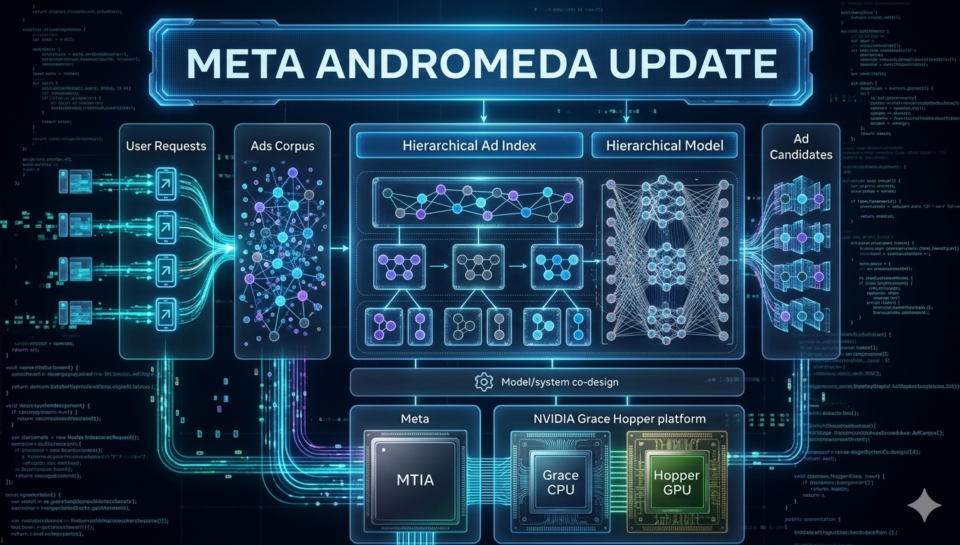
The meta Andromeda update flips this dynamic entirely on its head. Andromeda is an AI-driven retrieval engine powered by massive specialized hardware—specifically the NVIDIA Grace Hopper Superchip and Meta’s custom MTIA accelerators. It deploys machine learning models that are 10,000x more complex than the previous architecture.
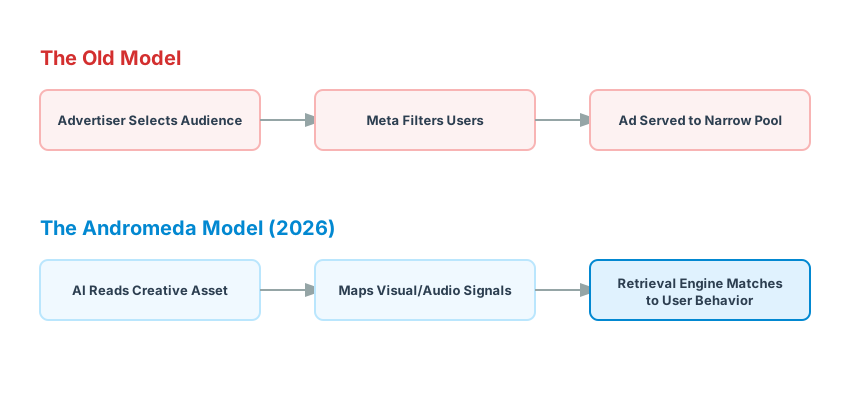
Instead of starting with your audience parameters, Andromeda starts with your creative. At the very first millisecond, an impression opportunity opens up, and Andromeda scans millions of active ads and uses computer vision and audio analysis to read the content of your video, image, hook, and script. It evaluates the visual patterns, the tone, and the product category, and builds an “Entity ID” for that ad.
The AI then evaluates deep, real-time user behavior metrics and matches your creative directly with the users most likely to engage. In short: In 2026, the creative is your target.
How Meta Andromeda Update Affects Ad Performance Across the Board
This structural change has triggered major performance shifts in performance marketing. Because automation has replaced manual structural setups, traditional media-buying tactics have become obsolete.
1. Manual Targeting Control is Obsolete
The days of meticulously stacking interest groups, testing lookalike audiences, and narrow age gating are effectively over. Lookalikes and tight demographic restrictions now act as anchors that restrict the AI’s learning capacity. Advertisers must shift to broad targeting parameters, allowing AI ad targeting to handle optimization via user-system interaction rather than preset user labels.
2. The 14-Day Creative Fatigue Wall
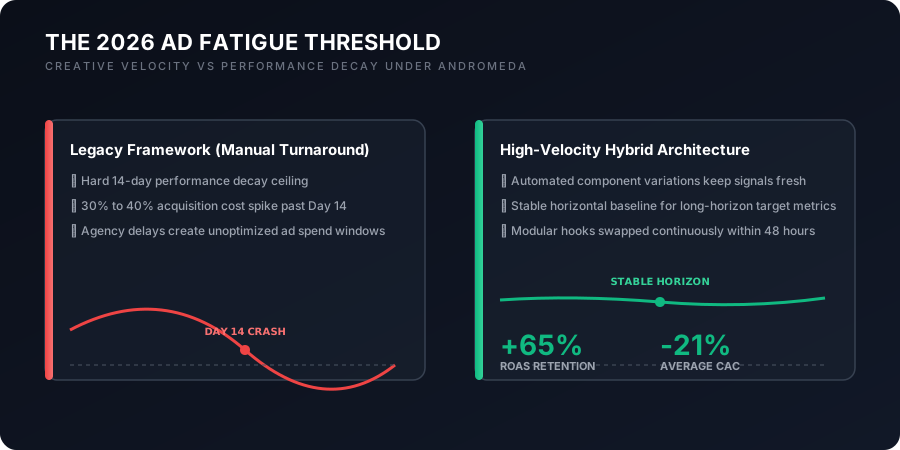
Because Andromeda processes massive datasets instantly, it maps your content to its ideal target audience far faster than older systems could. The downside? Ad fatigue hits much faster. A single ad concept that used to stay viable for 6+ weeks now burns through its addressable audience in 2 to 3 weeks. Once fatigue sets in, the system penalizes delivery, causing your CPMs to spike and your ROAS to decline.
3. The Demise of Slight Text Tweaks
Andromeda’s visual models recognize when an advertiser is simply submitting a “reskin”. Changing a single word in a headline or subtly altering the color of a button no longer registers as a new asset. The system applies “creative similarity” penalties if your library lacks real concept diversity, causing your ad account to learn more slowly and burn budget inefficiently.
The Impact of the Andromeda Update on Different Industries
The rollout of these Meta Ads changes in 2026 is affecting different industries in distinct ways, separating the brands that can scale content from those trapped in legacy workflows.
For E-Commerce and DTC Brands
E-commerce brands are experiencing the highest level of adaptation stress. Accounts running a single “hero” static ad or a limited set of clips are seeing conversion rates contract. Conversely, top performers are generating 33% more unique assets and leaning heavily into multi-creative formats like Advantage+ Catalog Ads and multi-angle user-generated content (UGC) to give the retrieval engine the diverse signals it requires.
For SaaS and B2B Platforms
Software products face a unique hurdle under Andromeda because their value propositions are digital and abstract. If a B2B SaaS brand relies on dry corporate talk or a flat product screen-recording, the AI engine can’t extract dynamic engagement patterns. SaaS brands must shift to high-velocity short-form video ads and polished AI-powered explainer creatives that visually display immediate workflow relief.
How Brands Should Adapt to Meta Algorithm Changes
To win in this new era of “Creative Darwinism,” brands have to shift their focus from tactical media buying to a continuous creative testing and generation engine.
The 2026 Rule of Thumb: You need a minimum of 8 to 12 conceptually distinct ad angles active per campaign—ranging from problem-focused stories to identity-driven testimonials—with continuous variations running to beat the fatigue cycle.
- Simplify Account Architecture: Collapse multi-adset structures into single, consolidated campaigns using Advantage+ Shopping (ASC) or broad setups. jetfuel.agency
- Prioritize Element-Level Variety: Test fundamentally different hooks, messaging tones, visual backgrounds, and human perspectives instead of making minor design edits. jetfuel.agency
- Protect Your Signal Quality: Because Andromeda learns from real-time customer behavior, your Meta Pixel and Conversions API (CAPI) data must fire flawlessly to maintain model accuracy. jetfuel.agency
Scale Your Paid Social with Fotyra’s Performance-First Engine
The real problem for most brands isn’t a lack of marketing strategy; it is the production bottleneck. Traditional agencies take weeks to deliver a single creative asset, and generic automated tools generate cold, robotic clips that consumers instantly ignore.
Fotyra is built specifically to bridge this gap, acting as your high-velocity, performance-focused production partner.
High-Velocity Creative Pipelines
We construct multi-layered creative pipelines—blending raw, high-trust UGC with cinematic UI treatments and clean, logic-driven statistics. We keep Meta’s Andromeda engine supplied with a consistent stream of distinct concepts, optimizing your campaign delivery and systematically driving down your target acquisition costs.
Authentic, Human-Centric Copywriting
We completely reject robotic scripts and empty corporate fluff. We craft simple, clear, and high-impact messaging that communicates with your audience partner-to-partner, ensuring your ad assets hold consumer attention and maintain strong brand authority.
True Risk-Reversal Business Strategy
We believe brands shouldn’t carry all the financial risk of creative testing. We throw out the outdated upfront retainer model. With Fotyra’s success-based partnership, you work within a zero-upfront-cost framework—meaning we align our objectives directly with your growth to help you secure consistent daily conversion volume.
As ad costs continue to rise, brands are shifting toward AI-powered production systems that significantly reduce creative production expenses while increasing output.

Conclusion
The Meta Andromeda update is not just another algorithm rumor. It reflects a real move toward AI-driven ad delivery, stronger creative ranking, and more automated performance optimization. Meta’s own 2026 update makes the direction clear: better creative, smarter ranking, and more AI-powered ad systems are now central to paid social performance.
For ecommerce, SaaS, and service brands, the message is the same. Creative quality, creative diversity, and creative speed matter more than ever. Brands that adapt will be better positioned to improve ROAS, reduce CAC, and stay competitive as Meta continues to shift toward AI-first advertising.
Ready to build ad creative that fits the new Meta Andromeda update? Book a strategy call with Fotyra to explore AI-powered ad production, UGC-style creatives, and scalable paid social assets designed for better performance.
FAQs
What is the Meta Andromeda update?
Meta describes Andromeda as a cutting-edge AI model that supports creative diversification and helps improve ad selection for different audiences. In practice, it is part of Meta’s AI-driven ad-ranking system.
How does Meta Andromeda affect ad performance?
Meta Andromeda update says its newer ranking systems improved ad clicks, conversions, and ad quality, which means creative relevance and variation are becoming more important for performance.
Why does Andromeda matter for ecommerce brands?
Ecommerce brands need more creative variety because Meta’s system is increasingly optimized to select ads that resonate with different users. More hooks, more angles, and more formats give the system more to work with. That is a practical inference from Meta’s update.
How should brands adapt to Meta algorithm update?
Brands should focus on creative testing, creative diversification, faster iteration, and better measurement. Meta’s update shows that AI-powered creative and stronger ranking systems now play a bigger role in delivery and performance.
How can Fotyra help with the Meta Andromeda update?
Fotyra helps brands produce AI-powered UGC ads, cinematic video ads, and scalable creative variations faster, which supports the creative velocity and testing volume needed in Meta’s AI-first ad environment.
